
Insider's Guide · Culture & Heritage
Morocco's Traditional Craftsmanship: Carpets, Zellij, Leather, Copper & Timeless Handmade Arts
A journey through the living workshops of Fez, Marrakech, Essaouira and the Atlas — where centuries-old techniques are still practiced by hand, and where a souvenir is never just a souvenir.
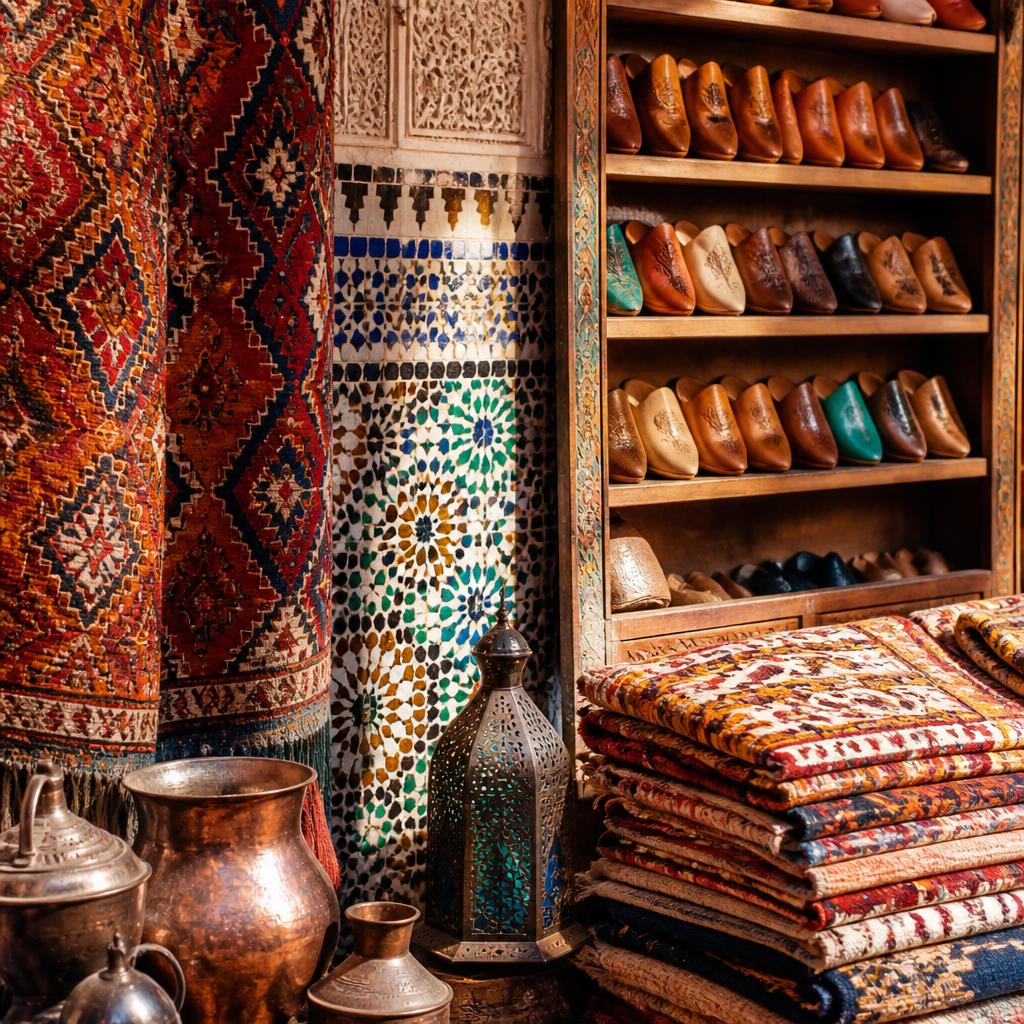
To walk through the medina of Fez at dawn is to walk through one of the oldest working craft cities on earth. A donkey passes carrying skeins of indigo-dyed wool. A copper hammer keeps time behind a cedar door. In a courtyard the width of two arms, a fourteen-year-old apprentice chips a single terracotta star out of a glazed tile — the same way his grandfather did, and his grandfather before him.
Morocco is one of the world's last great civilizations of the hand. Berber, Arab, Andalusian, Saharan and Jewish traditions have layered here for more than a thousand years, and every region still carries a signature: Fez for leather and Zellij, Marrakech for lanterns and carpets, Essaouira for thuya wood, Safi for blue-and-white ceramics, the Atlas for wool.
This is a traveler's guide to that living heritage — what to look for, where to find it, and how to bring a piece of it home in a way that honors the people who make it.
1 · Moroccan Carpets
A Moroccan rug is not a rug — it is a diary. Berber women weave the story of a marriage, a birth, a dream, or a protection against the evil eye, one knot at a time. No two are alike, and the finest are still made entirely by hand on vertical looms in villages that have no address on a map.
The main styles
- Beni Ourain — the famous ivory rug with charcoal diamonds, woven by the Beni Ourain tribes of the Middle Atlas from thick, undyed sheep's wool. Soft, warm, and unmistakable.
- Azilal — bright, poetic and abstract, from the High Atlas around Azilal. Cream backgrounds with bursts of red, pink and saffron; often reads like a piece of modern art.
- Boucherouite — the recycled-textile rug. Made from strips of old clothing when wool was scarce, these rugs are riots of color and among the most collectible in the world.
- Kilims (Hanbels) — flat-woven, lighter, often striped. Perfect for warmer climates and easier to pack.
- Rabati carpets — the courtly urban style from Rabat, with dense floral medallions and Andalusian influence.
The craft
Wool is sheared in spring, washed in mountain streams, hand-spun on a drop spindle, and dyed with plants: madder root for red, indigo for blue, saffron and pomegranate skin for yellow, henna for orange, walnut husk for brown. The loom is then warped with cotton and the weaver knots by memory — a single square meter can hold 40,000 knots and take a month.
The symbols
Diamonds mean feminine energy and protection. The Berber cross wards off the evil eye. Zigzags represent water and rivers. The scorpion is a talisman against harm. Read a Beni Ourain slowly and you will read a life.
Where to buy
- Marrakech — Souk des Tapis in the medina, and the government-backed Ensemble Artisanal for fixed, fair prices.
- Fez — the Nejjarine quarter and cooperatives around Place Seffarine.
- Rabat — the Oudayas kasbah and the artisan complex on Avenue Tarik Ibn Ziad.
- High Atlas villages — Aït Bouguemez and the weekly Berber markets around Azilal, straight from the weavers.
2 · Zellij — Morocco's Mosaic Language
Zellij is what happens when mathematics falls in love with faith. Small hand-cut terracotta tiles, glazed in a limited palette of white, cobalt, emerald, honey and oxblood, are assembled face-down into radiating stars — 8, 12, 16, sometimes 96 points — that seem to expand forever without ever repeating.
The craft arrived from Andalusia in the 10th century and reached its peak under the Marinid dynasty in Fez, where whole medersas were sheathed in it. A master maâlem can still, without a drawing, break a tile into forty geometric shapes with a small chisel called a menqach, then compose a wall from memory.
Where to see the greatest Zellij
- Medersa Bou Inania (Fez) — arguably the finest surviving Marinid tilework in the country.
- Medersa Ben Youssef (Marrakech) — recently restored, breathtaking at midday light.
- Bahia Palace (Marrakech) — courtyards of unrestrained color.
- Hassan II Mosque (Casablanca) — modern Zellij at monumental scale, executed by thousands of artisans.
- Royal palaces and historic riads — Fez, Meknes, Marrakech, Tetouan.
You will not carry Zellij home in a suitcase — but understanding it changes how you read every doorway in Morocco.
3 · Fez Leather — A Thousand-Year Tannery
The Chouara Tanneries in Fez have been operating in the same stone vats since at least the 11th century. Skins of goat, sheep, cow and camel are softened in a lime-and-pigeon-guano bath, scraped, then plunged into circular dye pits filled with poppy red, saffron yellow, indigo blue, mint green and henna orange. From the terraces above, the tannery looks like a painter's palette.
Visit at mid-morning, take the sprig of mint they'll offer you (hold it under your nose), and go up to one of the leather shops on the top floor — the balcony views are the best in Fez, and you're under no obligation to buy.
What to bring home
- Babouches — the pointed slippers, in every color. Yellow was traditionally worn by men, red by women.
- Poufs — sold flat and stuffed at home; a couple of empty ones fit easily in a suitcase.
- Handbags & totes — the softest leather you'll ever hold.
- Belts, wallets, notebook covers, jackets — often finished with hand-tooling.
4 · Copper & Brass — The Music of the Medina
Walk into Place Seffarine in Fez or the Souk des Chaudronniers in Marrakech and you'll hear the craft before you see it: a chorus of small hammers on beaten copper, from sunup to sundown. Trays as wide as a coffee table, teapots with swan-neck spouts, filigreed lanterns that throw star-shaped shadows on every wall — all shaped, engraved and tinned by hand.
Look for:
- Tea trays (siniya) — a proper Moroccan tea ceremony demands one; the best are engraved through the night.
- Teapots (berrad) — silver-plated brass with a curved spout, made for pouring from height.
- Lanterns (fanous) — pierced brass that turns a plain room into a Marrakech courtyard.
- Mirrors, bowls, and hammered wall sconces.
5 · Wood Carving — Cedar & Thuya
Morocco's two great woods are Middle Atlas cedar, warm and honey-colored, used for the carved ceilings and doors of every serious riad and mosque; and thuya, the fragrant burl wood that grows only along the Atlantic coast around Essaouira. Thuya's swirling grain and cinnamon scent make it perfect for small boxes, chess sets and picture frames.
- Essaouira is the world capital of thuya — walk the artisan workshops just inside Bab Marrakech.
- Fez — the Nejjarine (carpenters') quarter and its beautiful little museum in a restored funduq.
6 · Pottery & Ceramics
Two towns own the story. Safi, on the Atlantic, has produced glazed pottery since the 12th century — cobalt-and-white plates, tagines, and the striking green-glazed roof tiles of royal buildings. Fez is famous for its bleu de Fès — a deep cobalt on white, hand-painted with impossibly fine brushes.
Bring home:
- A working cooking tagine (heavier, unglazed base) — very different from the decorative version.
- Fez blue plates and bowls — beautiful, food-safe, and shippable.
- Safi's serving platters — the everyday tableware of Moroccan homes.
7 · Textiles — Kaftans, Djellabas & Cactus Silk
Moroccan textile traditions span the whole social calendar. The djellaba is the everyday hooded robe; the kaftan is its ceremonial cousin — hand-embroidered in silk thread, worn at weddings, and now a fixture on Paris and Milan runways. Add to that Sabra ("cactus silk") throws in candy colors, wool blankets from the Atlas, and delicate hand-embroidered scarves from Chefchaouen.
8 · A Traveler's Guide to the Souks
The souk is not a mall — it is a city. Each is organized by trade, and half the pleasure is getting lost.
- Marrakech — the largest and most theatrical, radiating from Jemaa el-Fna. Best for lanterns, leather, spices and carpets.
- Fez — the world's greatest craft medina and the most authentic. Best for Zellij, leather, brass and ceramics.
- Chefchaouen — small, calm and blue. Best for wool blankets, embroidery and goat cheese.
- Meknes — under-visited, honest prices. Best for damascened metalwork.
- Rabat — the Oudayas kasbah and its rug workshops.
- Essaouira — the thuya-wood capital and the friendliest medina in the country.
Shopping tips
- Spot the real thing. Turn a rug over — hand-knotted backs are slightly irregular. Copper should feel heavy; leather should smell like leather, not plastic.
- Bargain with grace. Offer 40–50% of the first price, settle around 60–70%. Smile, take the mint tea, walk away once if needed.
- Support cooperatives. Women's argan and weaving cooperatives pay artisans fairly and have fixed prices — a good baseline for what things should cost.
- Shipping. Reputable shops send via DHL / FedEx in 7–14 days. Get an itemized invoice for customs.
9 · Why Moroccan Craftsmanship Matters
When you buy a hand-knotted Azilal or a hammered tea tray, you keep a family workshop alive for another season. You also help preserve techniques that are, in many places, one generation from disappearing. Every purchase from a real artisan is a vote for a world that still makes things slowly, by hand, and beautifully.
10 · Practical Travel Tips
- Best cities for artisan shopping: Fez (depth), Marrakech (breadth), Essaouira (wood), Safi (ceramics), Chefchaouen (textiles).
- Best time to visit: March–May and September–November — pleasant weather and full workshops.
- Cash vs. card: Small shops and souks are cash-only (Moroccan dirhams). Larger galleries and cooperatives take Visa/Mastercard.
- Packing fragile purchases: Buy an empty rolling duffel in the medina for carpets and poufs; ask shops to bubble-wrap ceramics.
- Customs: Most countries allow personal-use crafts freely; carpets over a certain value may need a certificate the shop can provide.
Frequently Asked Questions
- What is Moroccan Zellij?
- Hand-chiseled geometric mosaic tilework that has decorated Moroccan mosques, medersas and palaces since the 10th century.
- Where can I buy authentic Moroccan carpets?
- Cooperatives in Fez and Rabat, the Souk des Tapis in Marrakech, and directly from weavers in High Atlas villages.
- Why is Fez leather famous?
- The Chouara Tanneries still dye leather in stone vats using natural pigments — a technique unchanged since the 11th century.
- Are Moroccan carpets handmade?
- Authentic ones are entirely hand-knotted on vertical looms, mostly by Berber women, from hand-spun wool.
- Is bargaining expected in Morocco?
- Yes in souks and small shops, no in cooperatives and fixed-price boutiques.
- What crafts is Morocco most famous for?
- Carpets, Zellij, leather, copper and brass, cedar and thuya wood, Safi and Fez pottery, and hand-embroidered textiles.
- Which city has the best artisan markets?
- Fez for depth and authenticity; Marrakech for the largest variety.
- How can I tell if a carpet is authentic?
- Slight irregularity on the reverse, lanoline-rich wool, and a cooperative certificate of origin.
- Can artisans ship purchases internationally?
- Yes — most established shops use DHL, FedEx or Aramex and deliver in 7–14 days.
- What handmade souvenir should I buy?
- Babouches and a brass tea set for a small budget; a Beni Ourain rug or engraved copper tray for a lifetime piece.